

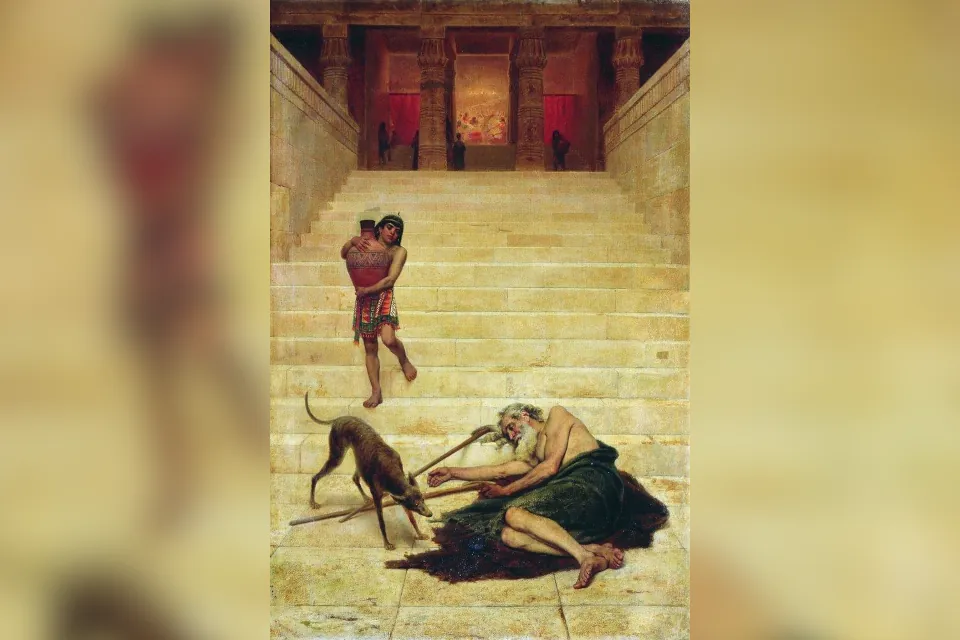
 Illustration of Lazarus at the rich man’s gate by Fyodor Bronnikov, 1886. (Wikimedia)
When Lazarus knocks at our door
(August 9, 2026/Davao City) — The Bukás Loób sa Diyos of which my wife Neng and I are members hold weekly Word Sharing Circle sessions at St. Paul’s Parish. But last June 23, instead of a WSC session, we listened to a taped teaching. The video was from the Toronto-based BLD Academy hosted by Tita Aileen Reyes.
The format was a conversation between Academy Chairman Tito Larry Nieva and Fr. Favin Alemao, Assistant Parish Priest of St Francis Xavier Parish in Mississauga District.
Tito Larry and Fr. Favin talked about Dilexi Te, (Latin for “I have loved you”), an apostolic exhortation written last year by Pope Leo XIV.
And as the reel began, I found myself sitting up for two reasons: 1) I was quite pleased with the BLD’s affirmation to meld spirituality with social justice, and 2) I was painfully aware—alright, ashamed—of my own shortcomings.
For example, I am content to offer money, clothing, or some other useful item to the less fortunate, whenever an opportunity is convenient. I feel that the gesture reflects my personal concern and complies, at the minimum, with the genteel expectations of noblesse oblige.
But tokenism is one thing. Compassion is another.
Charity is one thing. Social change is another.
To throw crumbs at Lazarus is one thing. To be in solidarity with him is quite another.
That last one refers to the famous parable narrated in the Gospel of Luke. It is cited by our two conversationalists to signify the poor’s omnipresence and their appeal for our love and support.
“Feel good”
Fr. Favin says compassion must “not be reduced to giving money” alone. And it must not be limited to mere words or perfunctory efforts that only make us “feel good.”
Intent must translate into action towards seeking out and providing for the poor’s real needs, safeguarding and even fighting for their rights. Such moves must “lift the poor out of their poverty, restore their dignity and help them build a new life.”
He had a phrase for it: A true follower of Christ must address “structures of sin.”
Indeed, the gist of Tito Larry and Fr. Favin’s talk was, to my mind, nothing short of radical. And if I am averse to walking down that extra mile, I am in for a grueling marathon.
To be fair, social responsibility is not unheard of. Latin America’s so-called “banana republics” in the 70s and 80s and the then concurrent dictatorship of Ferdinand Marcos, Sr. engendered the moral, communal duty to right societal wrongs.
In the early 1980s, the Mindanao-Sulu Secretariat of Social Action (Misssa, now defunct) of the CBCP tried to live out its mantra of serving “the poor, deprived, and oppressed” as it grandfathered community economic enterprises, responded to calamities, and documented state oppression of Church workers.
The latter was my professional nook, from where my co-workers and I traveled, interviewed priests and their parishioners, collated data, wrote, edited, took pictures, drew caricatures, and put out stories from our basement mimeographing machine.
Years later, under the corporate-led Philippine Business for Social Progress, we built classrooms, trained rural health workers, protected natural habitats, fed schoolchildren.
All these involved Mindanao’s poorest of the poor, the very same people referred to by Tito Larry and Fr. Favin in their conversation.
Vicarious
And yet, at the proverbial end of the day, why do I feel that they were all vicarious encounters?
It appears that the Pope himself has observed that, despite their—our—credentials, many of us today still feel detached from God.
Kudos may be in order for the big wins: A mass feeding here, a new farm-to-market road there. A women’s handicraft training here, a tilapia fingerlings dispersal there. But beneath it all, hunger and neglect rooted in “structures of sin” continue to fester.
Will looking them in the eye and holding their hands constitute no more than literal attention? But if that’s what it takes to ignite an impetus, perhaps there, in the palpable intimacy of human care, lies the real work. And true witnessing.
Pope Leo XIV likely knows this, having apparently drawn inspiration from his namesake, Pope Leo XIII. The latter was a 19th century pontiff known for his leanings toward social relevancy.
Long before the fiery temporal concerns erupted in the Second Vatical Council in 1962, Leo XIII had anxiously begun to imagine the Catholic Church in a volatile world, a world now defined by “rapid technological change, social fragmentation, and widening inequality,” according to a document quoted by Tito Larry.
Empathy
He is troubled, observed Fr. Favin of the Pope. And the latter has taken pains to “keep reminding us” of the “perennial” virtue of empathy.
Paraphrasing Scripture, Fr. Flavin asked, “How can we love a God we cannot see if we cannot love the poor whom we can see?”
Plainly said, too much needless pleasures, laziness, hate, and pride distract us from seeing the face of God in our brethren. And this is compounded even more by the unscrupulous application of Artificial Intelligence and robotics, the sheer power of consumerism, and an exponentially expanding social media universe.
Discernment, prayerfulness, and a conscious commitment to God—these may help redeem us.
Because as more Lazaruses now gather by our doorsteps, the heavier becomes the challenge to transform ourselves for the greater good, and ultimately for the greater glory of a loving God. (Nikki R. Gomez)
No Comments