

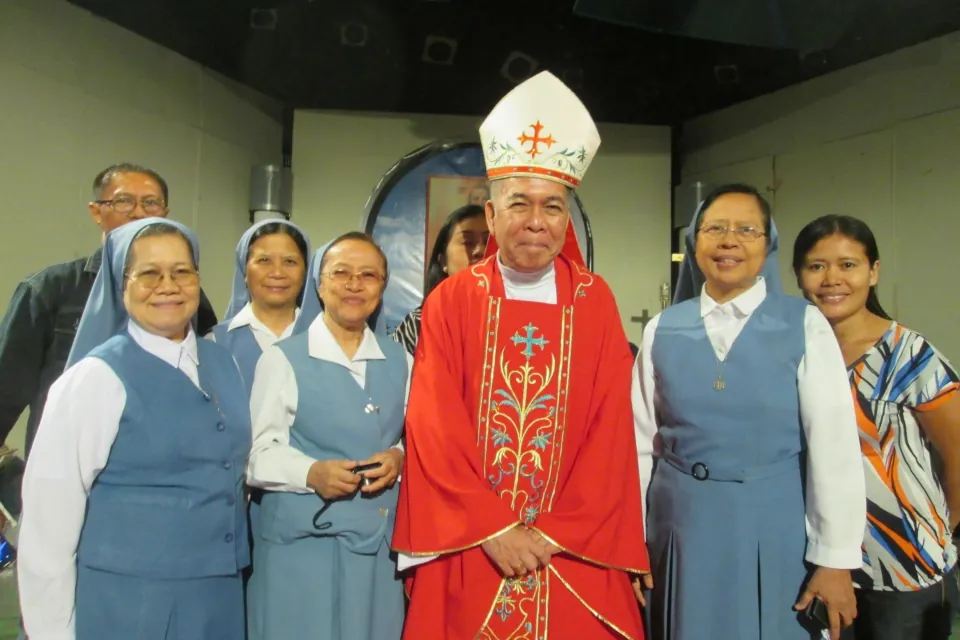
 Archbisho Romulo Valles during the Palm Sunday TV Mass with the Daughters of St. Paul sisters, April 2014. (Photo: Paulines Radio and TV Davao FB Page)
Pauline Presence in Davao: Communicating Christ through the Years
Can you imagine a world without smartphones, social media, and the internet? This question may seem impossible to answer for someone who belongs to this Generation Alpha (2013-2025), born into today’s world deeply immersed in the realities of Digital Communication and saturated with Social Media. Yet, those who belong to the recent past generations, such as Baby Boomers (1945-1963), Generation X (1965-1980), Gen Y (Millennials, 1981-1996), or Generation Z (1997-2012), can still recall the analog years they belong to.¹
During the Eucharistic adoration at the beginning of the new year and new century (December 31, 1899 – January 1, 1900), a bit ahead of his time, Blessed James Alberione received a light that awakened in him a zeal to spread the Good News to all people.² Later, he began to speak of an era in which this apostolic mission through the means of Digital and Social Communication would be employed by the Catholic Church even before these terms were conceived. Following the example of Saint Paul the Apostle, the apostolic zeal of Fr. Alberione wanted to bring the Good News to as many persons and places as possible by using fast and effective tools such as a printing press, books, films, and the like. In this light, Fr. Alberione founded the Pauline Family to live and work like, in the words of the founder, “St. Paul alive today.”³
The Pauline family, founded by Blessed James Alberione, is composed of five Religious Congregations: Society of Saint Paul (SSP, 1914), Daughters of Saint Paul (FSP, 1915), Sister Disciples of the Divine Master (PDDM, 1924), Sisters of Jesus the Good Shepherd (SGBP, 1938), and Queen of Apostles Institute for Vocations (AP, 1959).⁴
This Pauline Family also includes four aggregated Institutes of Secular Consecrated Life, all pontifically recognized in 1958: Institute of Jesus the Priest (IGP), Institute of St. Gabriel the Archangel (ISGA), Institute of Our Lady of the Annunciation (IMSA), and Institute of the Holy Family (ISF). This family also has a network of lay collaborators called the Association of Pauline Cooperators (APC, 1917).⁵
In the Philippines, the first Paulines, Italian missionaries Fr. Gaetano Marco Grossi, SSP and Fr. Matteo Bernardo Borgogno, SSP, arrived on July 7, 1935. They started a Pauline printing press in Lipa City, Batangas. They were also welcomed in the Archdiocese of Manila and, on August 10, 1941, started the Our Lady of Sorrows Parish in Pasay City.⁶ The Daughters of Saint Paul (FSP) arrived on October 13, 1938, with the first three Italian missionary sisters.⁷ The SSP and FSP missionaries collaborated and worked closely in the cities of Lipa and Pasay for the apostolate of Social Communication. Later, the other family members followed in the country, and the Pauline family began to spread throughout the country.
In the Archdiocese of Davao, the first Paulines arrived in 1953 with the presence of Sr. Gaetanina Modenese, FSP, and companions.⁸ They established the first Pauline community house in Davao at Bolton Street, near the San Pedro Cathedral. Two years later, around May of 1955, arriving at the then Sasa Landing Field, this new community was visited by the founder of the Pauline Family, Blessed James Alberione, and the first Mother General of the FSP, Venerable Tecla Merlo.⁹ The active and prolific presence of the FSP in Davao paved the way for other members of the Pauline family to follow some years later: the PDDM sisters in February of 1984, and the SSP priests and brothers on June 12, 2002.
Following the footsteps of Saint Paul the Apostle, Fr. Alberione also believed in the important potential of collaborators and began the Association of Pauline Cooperators in 1917. Gathering and forming collaborators or cooperators in the field of Social Communication has been a great part of the mission of the Paulines worldwide.¹⁰ Faithful to this task, in 1974, the FSP sisters began to involve and organize lay collaborators in Davao. Under Sr. Maria Pia, FSP, the Association of Pauline Cooperators of Davao came to light. This group of dynamic lay collaborators helped the FSP and later all other members of the family in various and numerous programs, radio and television productions, masses, recollections, and Pauline Family gatherings, to name a few.¹¹
Among the many contributions of the presence of the Paulines in Davao is the birth of Ang Taboan, the bi-monthly publication of the Archdiocese of Davao in 1973 headed by the FSP sisters. This publication is called the Davao Catholic Herald at present.¹² They also took part in radio programs and collaborated in the founding of the BTMC radio in 1968, currently known as DXGN. They also began the televised Mass, dubbed the Banquet of Love, for the sick and elderly in the year 1990, and it aired for 30 years.¹³
The presence of Paulines here in the Archdiocese of Davao provides a unique Pauline Color in the religious milieu of the Church in this region of Mindanao. The Paulines have propagated through their apostolic centers devotion and piety. They have enriched and nourished the Catholic faithful of the Church in Davao through their religious publications, reflections, articles, liturgical vessels and vestments, and various programs.
Since 1953, the Paulines have gone beyond the borders of Davao City and reached neighboring Dioceses like Digos, Tagum, Mati, Marbel, and more. Yet, the apostolic mission is far from finished. Now, more than ever, do we need to invest more resources, time, and training as we live in this deeply media-saturated world. The ever-changing landscape of media, technology, and communications continues to challenge all walks of life, including the church and its evangelizing mission in communicating the Good News in the midst of this ever-changing culture shaped by digital media.¹⁴
In a nutshell, this ongoing study aims to see the Paulines over the years through their presence and apostolic efforts here in the Archdiocese of Davao. It also hopes to see how this continued presence as it also evolves and develops in order to continue helping the Church in Davao deepen in faith and grow in the Social Communication apostolate, especially among the youth, as we all move forward in this digital age, toward the world of Artificial Intelligence.¹⁵
No Comments