

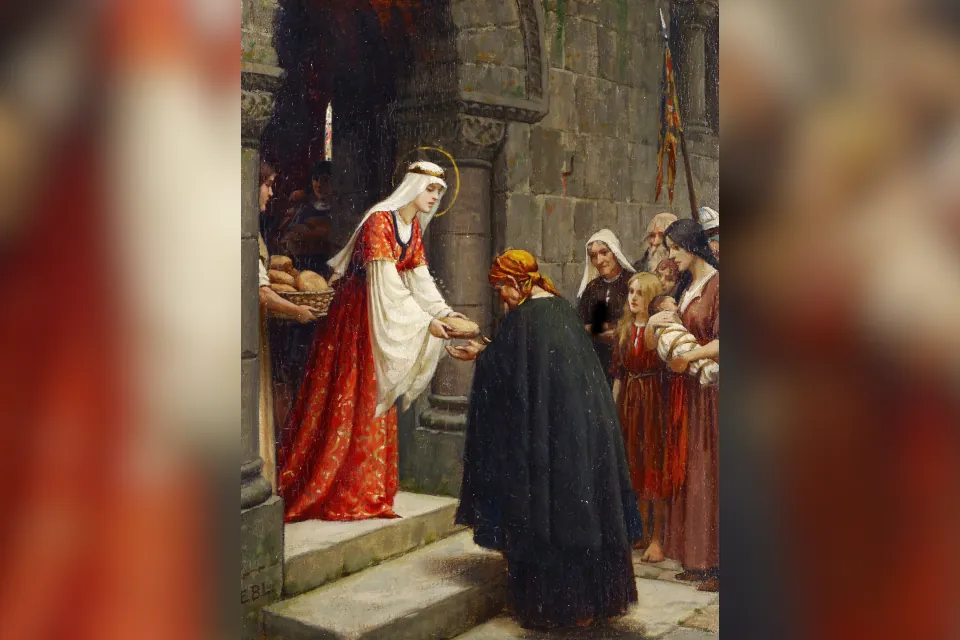
 The Charity of Saint Elizabeth of Hungary (circa 1895) by Edmund Blair Leighton
When Power Kneels: Saint Elizabeth and the Heart of Leadership
What does it mean to lead?
The world often connects leadership with position, authority, wealth, or the ability to make decisions for others. Saint Elizabeth of Hungary was born into that kind of power. As the daughter of King Andrew II of Hungary, she grew up surrounded by royal privilege. Yet she came to understand that having power over others did not mean placing herself above them. For Elizabeth, her position became an opportunity to serve.
Born in 1207, Elizabeth was married to Louis of Thuringia at a young age and became a wife and mother. She also became known for her care for the poor and sick. She gave food to those who came to her gates, visited the homes of the poor, cared for the sick, and eventually founded a hospital where she personally served those in need.
Her life gives a striking lesson for the World Day of the Poor. Poverty is not simply a problem for someone else to solve. It is an invitation to see another person with dignity. Elizabeth did not only give from a distance. She went toward the poor. She served them personally because she saw Christ in them.
This is where her example speaks to leadership, including those entrusted with public responsibility. Leadership is more than having the authority to make decisions. It carries a responsibility to seek justice, protect human dignity, and work for the common good. Pope Benedict XVI specifically presented Elizabeth as an example for those who hold positions of leadership, emphasizing that authority should be lived as service to justice and charity.
Saint Elizabeth also challenges the way we understand wealth. Having resources is not in itself wrong. What matters is what we do with what has been entrusted to us. Elizabeth could have remained within the comfort of the palace, yet she allowed her faith to move her outward. Her royal status did not become a wall between herself and the suffering. It became a responsibility.
There is something especially beautiful in this because leadership begins long before someone holds public office. Parents lead their families. Teachers guide their students. Employers care for workers. Community leaders make decisions that affect others. Even young people influence their friends and classmates. Each person, in some way, has the chance to use what they have for the good of others.
The World Day of the Poor reminds us that the poor should never become invisible. Saint Elizabeth reminds us that leadership should never become detached from the people it serves.
Perhaps true greatness is not found in how high we stand, but in how willing we are to bend down. The crown of Saint Elizabeth did not make her holy. It was the love with which she used what she had been given. Her life leaves us with a simple question: when we are given influence, resources, or responsibility, do we use them to place ourselves above others, or to help lift others? (Hannah Sulit)
No Comments